
The Importance of Empowerment in Social Work Practice
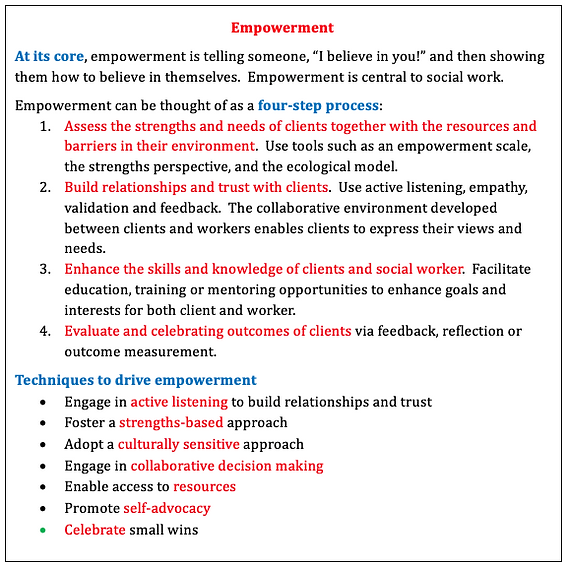
Empowerment is a fundamental concept in social work practice that focuses on enabling individuals and communities to take control of their lives and make positive changes. It involves providing support, resources, and opportunities for people to develop their skills, build self-confidence, and advocate for themselves.
Social workers play a crucial role in empowering their clients by helping them identify their strengths, set goals, and access the necessary services and support systems. By fostering a sense of agency and self-determination, social workers enable individuals to overcome challenges and improve their well-being.
Empowerment is particularly important in working with vulnerable populations such as survivors of abuse, individuals experiencing poverty, or people with disabilities. By empowering these individuals to voice their needs and preferences, social workers can help them navigate complex systems and advocate for their rights.
Furthermore, empowerment is not just about providing temporary solutions but about building long-term resilience and capacity. By equipping individuals with the tools and knowledge to address systemic issues that impact their lives, social workers can create sustainable change that extends beyond individual interventions.
In conclusion, empowerment is at the heart of effective social work practice. By empowering individuals and communities to become agents of change in their own lives, social workers can foster resilience, promote equality, and create a more just society for all.
Empowering Social Work Practice: 8 Essential Tips for Supporting Clients
- 1. Build trusting relationships with clients to empower them.
- 2. Encourage self-determination and involve clients in decision-making processes.
- 3. Advocate for the rights and needs of vulnerable individuals or groups.
- 4. Provide resources and information to help clients make informed choices.
- 5. Support clients in developing their strengths and skills.
- 6. Foster a sense of belonging and community for clients.
- 7. Challenge oppressive systems and work towards social justice.
- 8. Continuously reflect on your practice to improve empowerment strategies.
1. Build trusting relationships with clients to empower them.
Building trusting relationships with clients is a foundational tip in empowering social work practice. Trust forms the bedrock of any meaningful interaction, allowing clients to feel safe, respected, and understood. By establishing a strong bond based on trust, social workers create a supportive environment where clients feel empowered to share their experiences, voice their concerns, and actively participate in decision-making processes regarding their well-being. Trusting relationships not only enhance communication and collaboration but also lay the groundwork for effective interventions that promote self-empowerment and positive outcomes for clients.
2. Encourage self-determination and involve clients in decision-making processes.
Encouraging self-determination and involving clients in decision-making processes is a key tip in empowerment-focused social work practice. By recognising and respecting the autonomy of individuals, social workers can empower clients to take ownership of their lives and make informed choices that align with their values and goals. Involving clients in decision-making not only enhances their sense of agency and self-advocacy but also promotes a collaborative and respectful relationship between the social worker and the client. This approach fosters empowerment by valuing the unique perspectives and experiences of each individual, ultimately leading to more effective outcomes in social work interventions.
3. Advocate for the rights and needs of vulnerable individuals or groups.
In social work practice, advocating for the rights and needs of vulnerable individuals or groups is a critical aspect of empowerment. By actively speaking up and taking action on behalf of those who may not have a voice or face systemic barriers, social workers can help ensure that their clients receive the support and resources they require to thrive. Advocacy plays a key role in addressing injustices, promoting equality, and empowering vulnerable populations to access the opportunities and services they deserve.
4. Provide resources and information to help clients make informed choices.
In social work practice, providing resources and information to help clients make informed choices is a crucial aspect of empowerment. By equipping individuals with the necessary knowledge and tools, social workers enable them to make decisions that align with their goals and values. Empowering clients through access to relevant information empowers them to advocate for themselves, navigate complex systems, and ultimately take control of their own lives. This proactive approach not only enhances the client’s sense of agency but also promotes self-sufficiency and long-term resilience.
5. Support clients in developing their strengths and skills.
In social work practice, supporting clients in developing their strengths and skills is a crucial aspect of empowerment. By identifying and nurturing the inherent capabilities of individuals, social workers can help them build self-confidence, resilience, and the ability to overcome challenges. Encouraging clients to recognise their strengths not only boosts their self-esteem but also empowers them to take control of their lives and make positive changes. By focusing on skill development, social workers equip clients with the tools they need to navigate obstacles effectively and achieve their goals, ultimately fostering a sense of agency and self-determination.
6. Foster a sense of belonging and community for clients.
Fostering a sense of belonging and community for clients is a crucial tip in empowerment-focused social work practice. By creating a supportive environment where clients feel connected and valued, social workers can enhance their sense of self-worth and agency. Building strong relationships within a community not only provides emotional support but also offers opportunities for collaboration, shared learning, and collective action. When clients feel like they belong to a supportive network, they are more likely to engage actively in their own empowerment journey and work towards positive change in their lives.
7. Challenge oppressive systems and work towards social justice.
In social work practice, a key tip for empowerment is to challenge oppressive systems and actively work towards social justice. By recognising and addressing the systemic barriers that perpetuate inequality and marginalisation, social workers can empower individuals and communities to advocate for their rights and create lasting change. This proactive approach not only helps in dismantling oppressive structures but also contributes to building a more inclusive and equitable society where everyone has the opportunity to thrive.
8. Continuously reflect on your practice to improve empowerment strategies.
Continuously reflecting on one’s practice is a crucial aspect of enhancing empowerment strategies in social work. By taking the time to evaluate past interventions, successes, and challenges, social workers can gain valuable insights into what strategies are effective in promoting empowerment and where improvements can be made. This reflective process allows social workers to refine their approaches, adapt to the evolving needs of their clients, and ultimately enhance their ability to empower individuals and communities towards positive change.